
AI Tools for Beginners™
Before You Think About Buying Another AI Tool, Read This First
Buying another AI tool won’t automatically improve your results. Learning how to choose the right tool for the right job is where real progress begins.
If AI tools are starting to feel confusing, expensive, or scattered, the solution may not be another subscription. The better starting point is learning what problem you are solving, where each tool belongs, and how your tools should work together as a practical system.
Explore AI Tools for Beginners →
The smartest AI purchase begins before you compare tools.
AI tools can be helpful.
They can save time, organize ideas, support content creation, improve research, summarize information, and help you move faster.
But only when they are used with a clear purpose.
The beginner mistake is believing the next tool will automatically fix the problem.
That is how people end up with too many dashboards, too many subscriptions, too many features, and no clear workflow.
The issue is not always the tool.
The issue is often the missing system behind the tool.
Before buying another AI tool, you need to understand what problem you are solving, what role the tool plays, and whether it truly improves your productivity or decision-making.

More tools do not create clarity. Better decisions create clarity.

Key Idea
Owning more AI tools is not the same as building an effective AI system. Real progress begins when every tool has a clear job inside a workflow you understand.
More AI Tools Don’t Automatically Create Better Results
Buying another AI tool can feel productive.
It gives you the feeling that you are improving your business, upgrading your workflow, or preparing for better output.
But if the underlying problem is unclear, another tool may only add more confusion.
This is where tool accumulation begins.
You test one platform for writing, another for images, another for automation, another for research, another for video, and another for planning.
Soon, the work is no longer just the work. The work becomes deciding which tool to use.
That is when subscription overload starts to reduce productivity instead of improving it.
You may spend more time learning software than finishing projects.
You may chase features instead of solving the real problem.
You may compare tools instead of building a repeatable process.
“More AI tools can create more options, but more options do not always create better execution.”
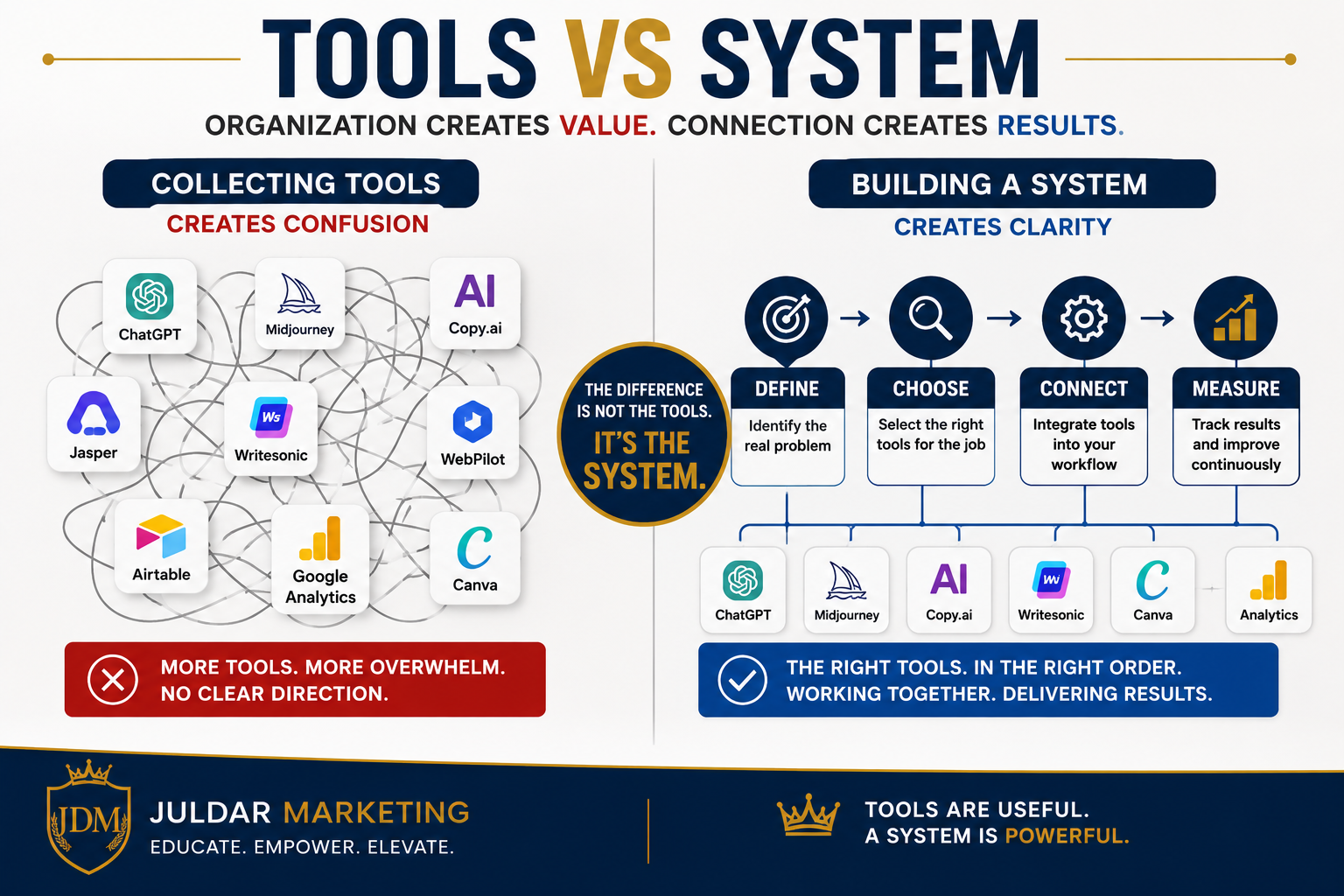
A tool collection gives you options. A system gives every option a purpose.
“The smartest AI decision is not always adding another tool. Sometimes it is learning how to organize the tools you already have.”
The Difference Between Collecting AI Tools and Building an AI System
Collecting AI tools means adding software without a clear operating structure.
Building an AI system means assigning each tool a clear role inside a repeatable workflow.
That difference matters.
A tool collection can look impressive from the outside, but still feel chaotic when you sit down to work.
A system may use fewer tools, but each tool has a purpose.
One tool may support research.
Another may help organize ideas.
Another may help draft content.
Another may help create visuals.
Another may help automate a repeated step.
The power is not in the number of tools.
The power is in how the tools work together.
A Smarter AI Implementation Path
Before chasing the next tool, check whether your AI decisions are connected to a clear workflow.
Choose the workflow before you choose the software.
Watch: Before You Think About Buying Another AI Tool
This short educational video explains why another AI tool may not be the real solution, and why better AI results usually begin with clearer decisions and stronger workflow thinking.
If you have been judging AI progress by how many tools you own, start looking at whether those tools are actually improving your workflow.
Explore AI Tools for Beginners →The Four-Question AI Tool Decision Framework™
Before you add another AI tool, slow the decision down.
The goal is not to reject new tools.
The goal is to make sure the tool belongs in your system before it becomes another distraction.
- What problem am I trying to solve? Start with the actual task, bottleneck, or decision you are trying to improve.
- Can one of my current AI tools already solve it? Avoid paying for duplicate functions before reviewing what you already have.
- Where does this tool fit within my workflow? Every tool should have a clear place in the process.
- Will this tool actually improve my productivity or decision making? The tool should reduce friction, not add more complexity.
The gap is often not access to AI.
The gap is knowing what each tool should do and when it should be used.
Simple Rule
If you cannot explain what problem the AI tool solves, where it fits, and how it improves the workflow, you may not be ready to buy it yet.
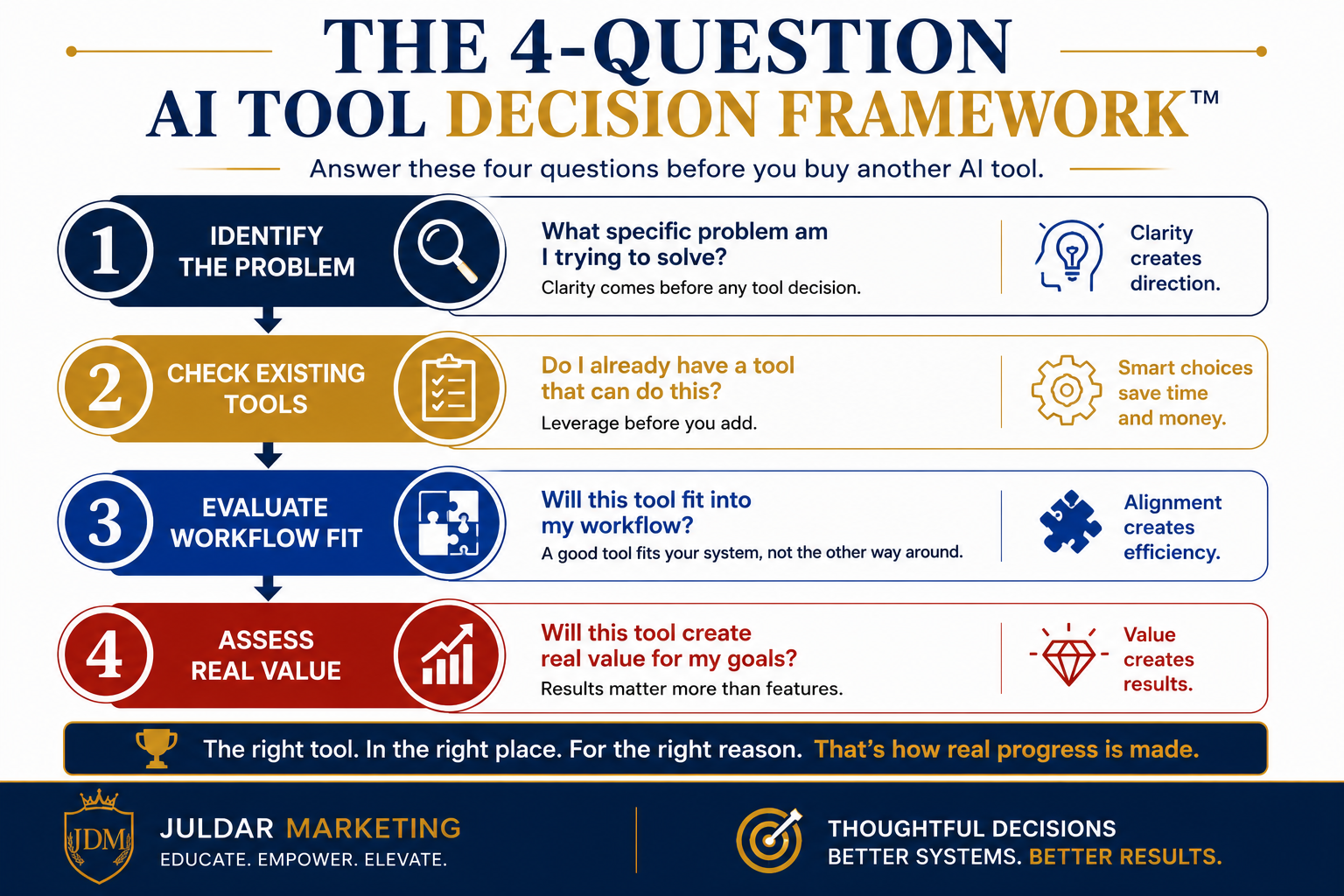
A useful tool should solve a defined problem, fit a real workflow, and improve a measurable result.
A Practical Example of Better AI Tool Selection
Suppose you want to create educational content faster.
The beginner mistake is to search for the newest AI content tool.
The smarter move is to break down the workflow first.
You may need research support, outline support, draft support, editing support, image support, and publishing support.
Once those stages are clear, you can decide which tool belongs at each stage.
You may discover that one tool can handle several tasks.
You may discover that a tool you already own is enough.
You may also discover that a new tool is worth adding because it solves a real bottleneck.
This is how AI becomes a system instead of a software collection.
Four-Question Framework Summary™
1. What problem am I trying to solve?
2. Can one of my current AI tools already solve it?
3. Where does this tool fit within my workflow?
4. Will this tool actually improve my productivity or decision making?
Smarter AI Decisions Produce Better Long-Term Results
Intentional AI adoption may feel slower at first.
But it protects you from wasted subscriptions, duplicated tools, and scattered implementation.
When you choose tools with purpose, your workflow becomes easier to manage.
You know what each tool does.
You know when to use it.
You know what result it should support.
That makes improvement easier because you are not guessing from one tool to another.
You are improving a system.
That is why thoughtful decisions consistently outperform impulsive software purchases.
New tools will continue to appear.
Some will be useful.
Some will be unnecessary.
The difference is your ability to evaluate them before they enter your workflow.

The goal is not owning the most AI tools. The goal is building the right AI system.
The Goal Is Not Owning the Most AI Tools
The goal is building the right AI system.
That system should help you think clearer, work faster, reduce repetitive effort, and make better decisions.
It should not make the work feel heavier.
It should not require you to keep switching platforms without a reason.
It should not create more confusion than clarity.
When AI tools are selected correctly, they support your process.
When they are selected impulsively, they often become another problem to manage.
Better AI results begin with better AI decisions.
Problem → Purpose → Workflow → Tool Fit → Results
JulDar Marketing Strategy Reminder
AI Tools Work Better When They Belong to a System
Before buying another AI tool, identify the problem, define the workflow, review your current tools, and decide whether the new tool truly improves the way your work gets done.
Start With AI Tools for Beginners™
You do not need to keep buying AI tools just because they look useful.
You do not need to keep guessing which tool belongs in your workflow.
You need a clearer way to understand what AI tools do, how they fit, and when they are worth using.
AI Tools for Beginners™ was created to help you start with clarity before you invest more time, money, and energy into the wrong tools.
Explore AI Tools for Beginners →Continue Your AI Learning Path
Explore Helpful Starting Points
These related resources can help you think more clearly about AI tools, online income, digital products, and the systems behind practical implementation.
JulDar Educational Resource Network™
Explore More Clarity-Based Resources
Continue exploring trusted educational resources designed to help you make informed business, wellness, and lifestyle decisions.
Business Clarity
Online income, AI, work-from-home, and digital business decision resources.
Visit JulDarMarketing.com →Oral Wellness Resources
Educational quizzes, guides, and resources for oral wellness decision support.
Visit FreshBite.net →Blood Sugar Awareness
Educational resources focused on awareness, lifestyle decisions, and informed choices.
Visit BloodSugarProblem.com →Created by JulDar Marketing • JulDarMarketing.com
Educational-use notice: This article is for educational and informational purposes only and does not provide financial, legal, tax, employment, business-formation, monetization, advertising-compliance, platform-policy, or guaranteed income advice. No income results are promised or guaranteed.