For beginners who want better AI results
Better Prompts. Better Answers. Better AI Results.
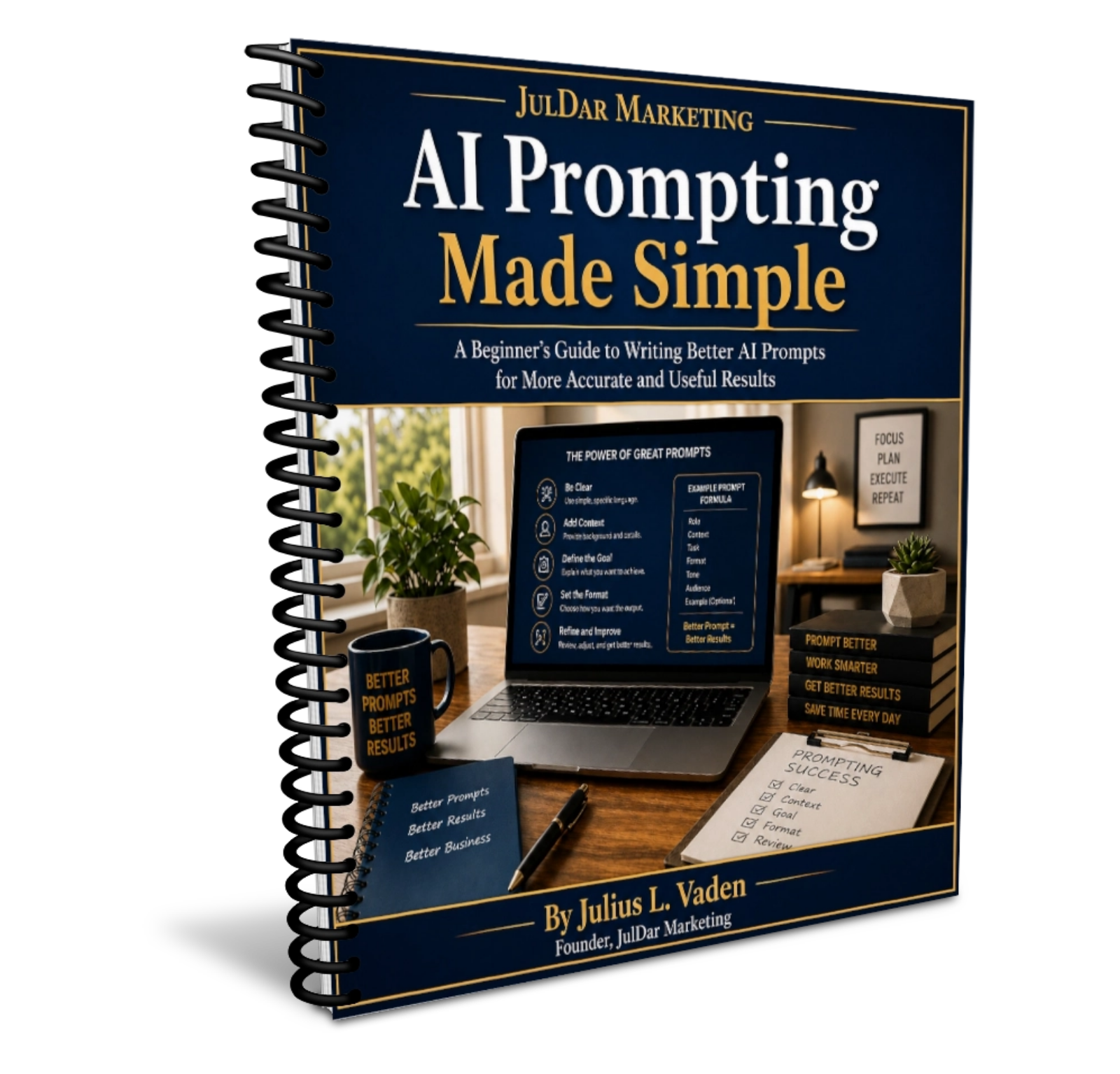
AI Prompting Made Simple™ helps you communicate more effectively with artificial intelligence so your prompts produce clearer, more accurate, and more useful responses.
Many people try AI tools and feel disappointed because the answers come back too broad, too generic, or not useful enough. The problem is often not the AI tool itself. The problem is usually the way the request is written.
This guide helps you understand prompting as a practical communication skill so you can give better instructions, provide stronger context, define the output you want, and improve results through simple refinement techniques.

Why AI Responses Often Miss the Mark
Artificial intelligence can be powerful, but it responds to the instructions it receives. If the prompt is vague, incomplete, or missing context, the response may also be vague, incomplete, or misaligned.
Stronger prompting helps you move from random results to clearer, more intentional outputs that are easier to use, edit, and apply.
Move from Vague Requests to Clear AI Instructions
This guide helps you stop asking AI broad questions and start giving it better direction.
Learn how specificity, context, audience, tone, and format improve AI responses.
Avoid common prompting mistakes that lead to generic or unusable answers.
Use follow-up prompts to improve, shorten, expand, simplify, or restructure AI-generated content.
Save time by turning your best prompt patterns into repeatable business and marketing tools.
Who this guide is for
- Beginners who want better results from AI tools without technical confusion.
- Small business owners who use AI for content, planning, research, or marketing.
- Solopreneurs and freelancers who want reusable prompt templates for common tasks.
- Readers who get vague AI responses and want to understand how to improve them.
- Anyone who wants to communicate with AI more clearly and productively.
What this guide helps you do
The goal is not to turn prompting into a complicated technical process. The goal is to help you communicate more clearly.
You will learn how to give AI stronger instructions, include the right context, define the output format, avoid weak prompts, and improve responses through simple follow-up requests.
What’s inside the guide
Understand prompting as the foundation of effective communication with artificial intelligence.
Learn how clearer instructions reduce ambiguity and improve AI output quality.
Use task, context, audience, format, tone, depth, and requirements to guide better responses.
Identify the mistakes that lead to weak, vague, or unreliable AI responses.
Apply reusable prompt structures for articles, emails, social posts, sales copy, proposals, and more.
Use role prompting, step-by-step instructions, constraints, comparisons, and prompt chaining without technical overwhelm.
What you receive
AI Prompting Made Simple™ — PDF Guide
Immediate download access after purchase. Use it to improve your AI prompts, generate clearer responses, build reusable templates, and communicate with AI more effectively.
Quick FAQs
Yes. This guide explains prompting in plain language and does not require coding, technical experience, or advanced AI knowledge.
Yes. Prompting principles can be applied across many AI writing, research, content, planning, and productivity tools.
Because it teaches a practical, reusable skill that can improve your results across many AI platforms and business tasks.
After purchase, you are redirected to your access/download page.
Ready to Start Getting Better Results from AI?
Get AI Prompting Made Simple™ and start communicating with artificial intelligence more clearly, confidently, and effectively.
Get Instant Access & Start Writing Better Prompts →Want the full JDM AI Intelligence Bundle instead?
If you also want beginner clarity, tool categories, decision support, cost-control guidance, workflows, implementation planning, and advanced AI business systems, the full JDM AI Intelligence Bundle gives you the broader learning path in one stronger-value package.
View the Bundle →